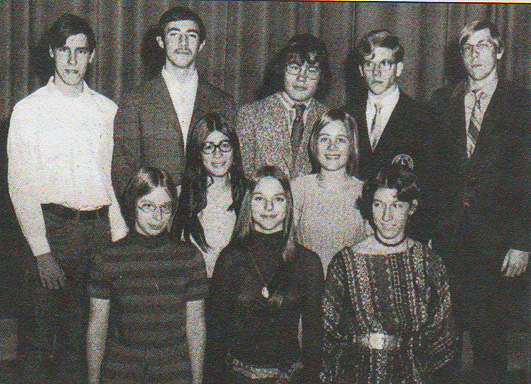
The first members of SEQ from the 1971 BHS yearbook picture.
Members 1970's
Bellport High School’s (“BHS”) Students for Environmental
Quality (“SEQ”) club, was officially started in September of 1970. Ron
Rozsa (BHS ’71), one of the founding members and first “chairman” of
SEQ, remembered, “It was to be the last of Art Cooley’s summer Marine
Biology classes — the very last day of the trip and the return from
Montauk Point. On the bus ride home I discussed with my colleagues,
probably Linda and John Jensen and Charlie Shellabarger, the idea of
SEQ. We may have even devised the name on the bus. The class also
decided to donate our well-worn, muddy sneakers to the school and we
tied them all together, leaving the school barefoot.”
That September, when school resumed, Ron Rozsa organized the
first meeting of SEQ. This meeting’s purpose was to strategize over what
SEQ was to actually do. Meeting “occasionally,” this group of between ten
and fifteen students, mostly juniors and seniors from Cooley’s Marine
Biology Class, decided on tackling two problems: 1. East Patchogue’s
Dodge Dealership spilling oil into Swan Lake and 2. Writing to New York
State Senator Bernard C. Smith regarding the killing of harbor seals in
Moriches Inlet. (It was Senator Smith who introduced the bill in New
York State that prohibited the killing of seals, which later became law in
1972.) These goals set into motion what was to define SEQ – environmental
awareness and political activism!
The first members of SEQ from the 1971 BHS yearbook picture.
Possibly the ultimate compliment to Cooley, Rozsa
pursued his
studies in marine biology, then, coastal ecology, followed by plant ecology
in graduate school. Today Ron is a Coastal Ecologist in the Office of
the Long Island Sound Program for the Connecticut Department of
Environmental Protection.
Mike Butler (BHS ’74) was another member from the original
group that started SEQ. A member for all four years, Butler was in the
SEQ canoe that “defeated” the League of Women Voters (“LWV”) challengers
in a race that was staged on the Carmans River on Sunday, March18, 1973.
The race was held to publicize a bill before the New York State
Legislature that was aimed at getting the Carmans River listed as a “study
river.”
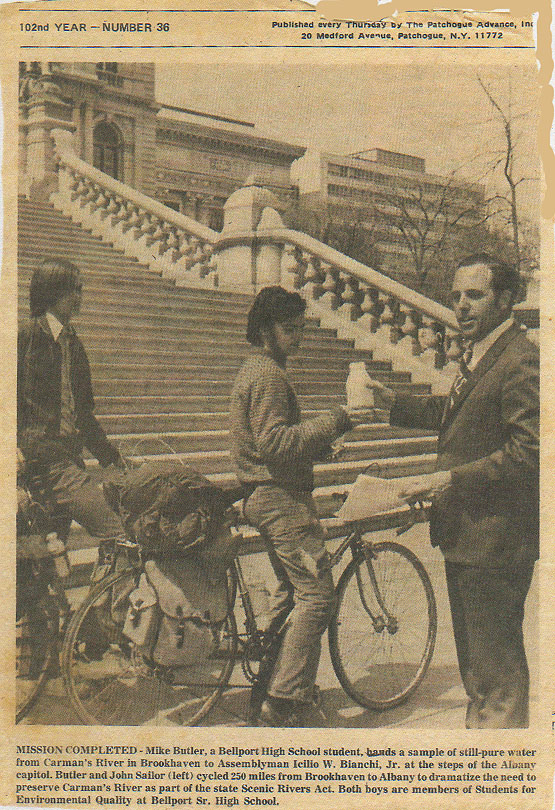
The Advance, April 4, 1973
With this much needed publicity, Butler recently recalled
that he
and fellow SEQ member, John Sailor (since deceased), decided to take a
bike ride all the way to Albany and back to further publicize the bill.
According to Butler, “The bicycle trip was conceived as a publicity stunt
to jump start the bill’s chances. New York State Assemblyman Bill Bianchi
was a freshman Democrat in a Republican controlled Assembly.” Besides
handing Mr. Bianchi a bottle of “still-pure water” from the Carmans
River.
Butler and Sailor “were introduced to a lot of politicians
and presented
a petition (from concerned local residents) to Assembly Speaker
Perry Duryea. “All of the publicity worked as the Carmans River was
eventually accepted as a “study river” in May 1973. Now all that was needed
to protect the natural state of the Carmans River was for New York
State’s Department of Environmental Conservation (“DEC”) to recommend
that the river be protected by the Wild, Scenic, and Recreation of
Rivers Act (“WSRRA”), which was an amendment to New York State’s
1970 Conservation Law.
SEQ decided to help the DEC with its studies of the river.
Butler
stated, “The idea of doing the study was to speed up the DEC regulation
writing process. John and I were more into the legal and zoning aspects of
the preservation; Pam Borg, Elizabeth Shreeve and others were well
versed in the flora and fauna of the river corridor.” Building upon the earlier
work of students in Cooley’s spring 1970 Topics in Biology/Advanced
Biology class, including Joseph Beitel and Helen Gelband, 1973’s SEQ
group of twenty-two students wrote a detailed report that they submitted
to the DEC and to a supportive New York State Senator, Mr. Leon E.
Giufreda, in January of 1976. Six months later, then New York Governor
Malcolm Wilson signed the Carmans River Protection Act.
Butler noted that he was also involved in “getting signatures
for
the petitions supporting the New York State Marine Mammal Act (1972)”,
and spending a lot of time on Mr. Dennis Puleston’s farm. “Dennis
Puleston would catch birds in nets, band them and release them, Advanced
Biology and Taxidermy/Ornithology were great courses. Art always made
us think…”
Like Rozsa above, Scott Stoner (BHS ’75) continued his SEQ
interests, today managing New York State’s Water Quality Standards
Program for the DEC in Albany. Stoner recalled that “I was active in SEQ
for all four years at BHS and its vice-chair in ’74 to ’75.” Three specific
events stood out in his mind: 1. Petitioning for a New York State Bottle
Bill at Smithaven Mall, 2. Speaking before the Suffolk County Legislature
and asking for their assistance regarding a home rule message in support
of a statewide bottle bill, and 3. An anxiety-filled trip to Jamaica, Queens
for a bottle bill public hearing: “Four of us took the day off from school
to present SEQ’s position in favor of the bill. I think we were the only ones
there in support of it. The others who participated were Arvid Friberg
(BHS ’75), Joe Grispino (BHS ’76), and Steve Rabin (BHS ’77) . . . I had
prepared the written position statement and we ‘elected’ Steve to get up
there and give the presentation . . . the very large room was packed with
very large, rough-looking men, who were attired in union or beveragelabeled
uniforms. They were adamantly opposed to any effort to impose a
bottle bill. After Steve bravely articulated our position . . . we scooted out
of there, jumped in our car, and didn’t stop until we were safely home.” In
the spring of 1975, Stoner and several others even traveled to Albany for
a student environmental congress at the State Capitol. Again, political
activism seemed to be the focal point of SEQ’s existence.
Steve Rabin (BHS ’77), who served as SEQ chairperson for his
senior year, related that he had many fine memories, including working on
the bottle bill and later seeing it become law in New York State in 1982.
“We probably ticked off a bunch of teamsters and grocery store owners in
the process, but sometimes you can’t please everyone to do what is right!”
“Trash-a-thons” were another major effort of SEQ. “We wanted
to have a forum to distribute information and raise interest in some of the
important issues (the bottle bill, Carmans River protection, spaying/neutering
pets, etc.); so we came up with the idea of the trash-a-thon; people
would donate money to our causes on which we educated them and, in
return, we’d clean up areas in our neighborhoods.”
Rabin also mentioned Tony Sutin (since deceased) as being a
key
contributor to the club. “Tony was co-chair the year I was chair (1977),
and he really set the tone with intelligence and class… Tony was a real
driver in getting things done. He was a good friend whom we all miss.”
It should be noted that Sutin was tragically killed on
January 16,
2002 by a student at the Appalachian School of Law in Grundy, Virginia
where he was both Dean and Associate Professor of Law. We offer our
respect to Sutin for encompassing the true meaning of SEQ and the powerful
relationships it helped to foster.
Rounding out our interviews of SEQ’s first decade (of
existence),
we interviewed Anthony Graves (BHS ’78). Graves explained that before
entering BHS, he “had heard of a student at Bellport riding his bike to
Albany with a jar of water from the Carmans River in order to draw attention to
the efforts to make the river a Wild and Scenic River.
|
|
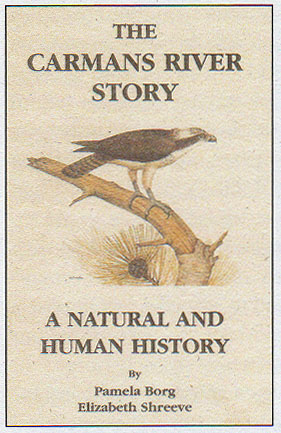
| The Carmans River Story - |
| A Natural and Human Story |
|
first edition, April, 1974 |
I had also read the “Guide tothe Plants and Animals of Carmans River”
that was written by Bellport High School students, and I was impressed…” Graves’
reference to Michael Butler (and JohnSailor) bicycling to Albany and meeting
with New York State legislators, and the published efforts Pamela Borg and
Elizabeth Shreeve inspired Graves to join SEQ. He had already met SEQ advisor,
Cooley, and his parents were friends with Dennis Puleston and his wife. They all
used
to meet on the Puleston property to help band migrating birds they caught in
“mist
nets” during their fall migration south.
Although Graves couldn’t recall being an officer of SEQ, he
stated that he was chairman of the Marine Mammal Alert, “a subset of
SEQ that would be alerted if a whale or dolphin washed up on a beach.”
Besides attending one of the first Marine Mammal Symposiums held in
this country with Cooley and a number of other SEQ members on Cape
Cod, Graves shared another local story that is both educational and amusing.
“We got a call that a dolphin had washed up dead on the shore in East
Patchogue. We couldn’t find anyone with a truck so I borrowed my
parents’ station wagon and Jonathan Cooley (BHS ’79), who is the son of
Mr. Art Cooley and now an expedition leader for his own company with
National Geographic in Fruita, Colorado, and Lee Snead (BHS ’78), who
was vice president of SEQ his senior year, and is now a Bellport Village
Trustee and an attorney specializing in environmental issues, and I
managed to use a board as a ramp and get this three hundred pound dolphin
into the back of the station wagon. Somehow we got it into the freezer
at school. It turned out to be a very rare animal, a Gray’s Grampus. A
scientist came to the high school from the Smithsonian and dissected it.
We got to attend the dissection and help him.”
Additionally, Graves mentioned that SEQ continued working on
the recycling of glass, paper and metal, and that “we may also have written
letters asking that Fire Island Wilderness Area be officially designated
and protected. Now it is protected, and it is the only federally designated
wilderness in New York State.” He also won a Presidential Environment
Awareness award for writing letters requesting an investigation of a case
concerning the shooting of a bald eagle, which was on the endangered
species list.
Today, Graves works for the Town of Brookhaven’s Department of
Environmental Protection. Using his vacation time, he also works as a
professional naturalist for several cruise ship companies specializing in
trips to unique nature destinations such as the Galapagos Islands and the
Amazon River Basin. He started out working for Lindblad Expeditions
thanks to his contact with Cooley and Dennis Puleston, but he now also
works for Zegrahm Expeditions and TCS Travel.
His advice to present and future SEQ members is to “follow your
interests! Life is short, money isn’t everything, make sure you have fun,
choose a career that interests you, don’t be afraid of mistakes, listen to
advice- but mostly listen to yourself.”