Members Century 21
Tiffany Russo (BHS ’01) was an officer in SEQ during her last two
years at BHS. Her attraction to the club is an often-repeated response to
one of this project’s key questions: “I was attracted to SEQ by my love of
the environment and my commitment to trying to protect it.” She added
that, “All of my friends were also in the club and shared this common
interest with me. So it was a safe haven of sorts for us ‘nerds’ and a place
where we could try and make changes, even if they were just little ones, in
our school.”

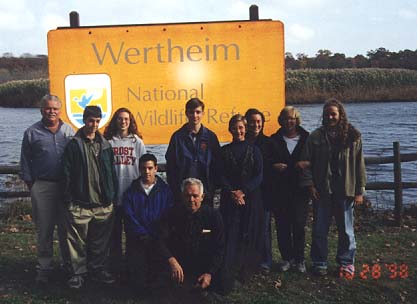
Science Chairman Jim McGowan, Marv Loewen, Brookhaven Town
Supervisor Brian Foley, Ann Carpenter, Lois Edzel, Art Cooley and
SEQ members at the Wertheim National Wildlife Refuge.
Additionally, Russo shared that in her three years of SEQ membership
(1998-2001), “membership was great - averaging about fifteen to
twenty people.” Her most memorable activity was the numerous
“cleanups” the club did throughout the local area. She also recalled a
successful
fundraiser involving the sale of t-shirts sporting pictures drawn by
two of SEQ members and an attempt to recreate a school recycling program,
which unfortunately failed due to “lack of support from other
groups involved.”
Lastly, Russo commented on the club continuing its overnight
trips to the Mashomack Nature Preserve on Shelter Island (as first mentioned
above by O’Connor) where they weeded some “invasive species”
from the preserve grounds and viewed a slide show from Cooley. The club
initiated these trips in the late 1990s under the advisorship of Marv
Loewen and with the help of Mr. Michael Scheibel, a local Brookhaven
Hamlet resident.
Maureen Gundlach (BHS ’01) reported that she was thrilled to see
our ad in The Advance (Dec. ’05) about the club’s intention to write this
History of SEQ. Her email noted the transition of advisorship from Mr.
Marv Loewen to Ms. Lois Etzel; her use of the compost bin in the Atrium,
which was then being actively used by SEQ, the custodians and Mr.
Dunton’s class; and the club’s two trips to the Mashomack Nature
Preserve during her four years of membership. On these trips she remembered,
“dragging brush from a field, hiking on the preserve property,
yanking some non-native plants, and most memorably, listening to Art
Cooley who gave a lecture about his recent trip to Japan and New
Guinea.”
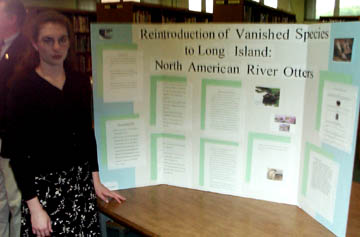
She added that she did her “authentic research class” project at the
local Wertheim National Wildlife Refuge and that she found several of its
employees to be particularly helpful, especially Mr. Bob Parris and Ms.
Patricia Martinovak.
Nikki Frankel (BHS ’05) was the president of SEQ, after serving
the previous year as vice president under Andrew Dunbar (BHS ’04). She
recalled several experiences including having a “scary” room for BHS Safe
Halloween to help the community and increase awareness about our club.
She also spoke of canoe/kayak trips on the Carmans River organized by
then advisor, Mr. George Ruland. “This was more of an appreciation for
nature and our local resource type of thing.”
Additionally, Frankel stated an often-repeated sense of frustration
with in-house recycling. “We also tried to get BHS to recycle on a more
continuous and proper basis with flyers posted in hallways educating others
about what should and shouldn’t go into the blue recycling garbage
bins, but I don’t think we had that great of an impact.”
During her senior year, she continued attending South Shore
Estuary Reserve Council Citizens Action Committee meetings at the
Suffolk County Maritime Museum in West Sayville and, along with thenvice
president Jeffrey Schait, “we worked on establishing the History of
SEQ project by securing a grant [from the SCEF] under Mr. O’Connor’s
leadership and guidance… the club didn’t have a ton of members then, but
the ones that did consistently show up were genuinely committed and
interested.” Lastly, she noted that SEQ looked into “restoring a house on
Beaver Dam Creek that had the potential to be some sort of meeting
place, but it was pretty run down.”
Unknown to Frankel until this interview took place, the Post-
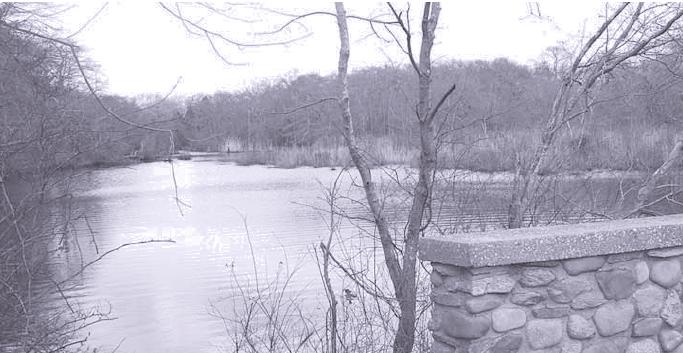
Morrow-owned cottage on Beaver Dam Creek (the “Tooker’s House”),
right next to the often photographed bridge, is presently being rehabilitated
by the combined efforts of Post-Morrow and SEQ. Its future use as
a meeting place relies on funding efforts for its true restoration.
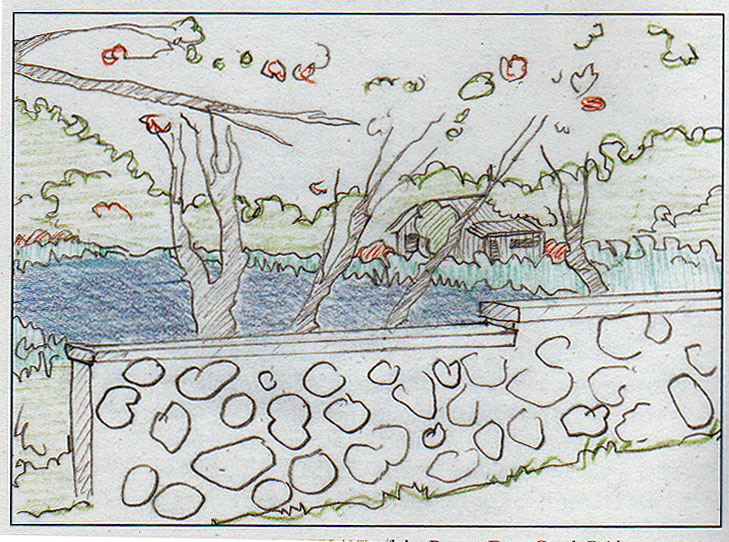
Drawing by Tyler Healy (BHS ’07) of the Beaver Dam Creek Bridge