 USS NEW
YORK BB-34 USS NEW
YORK BB-34 |
|
|---|---|
| HISTORY 1919 - 1926 | |


Radio Call Sign: November - Alpha - Delta - Tango |
|
| Click On Image For Full Size Image | Image Description |
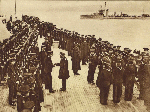 |
"Preliminaries to Surrender of the German Fleet. U. S. Admiral Rodman, accompanied by Admiral Sims, extending a cordial greeting to King George of England as the latter came on board the New York (BB-34), the flagship of the American Dreadnought squadron." |
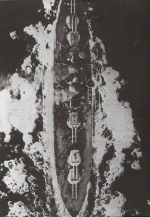 |
Overhead of the ship taken in 5 January 1919, while she was steaming at 17 knots. Taken from a kite balloon at 1000 feet which increased visibility of the ship's spotters. Long barreled 5"ers and derrick top 3"ers are easily visible. |
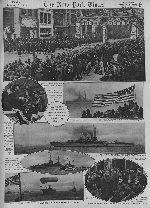 |
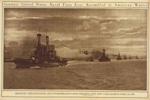
Front page of the N.Y. Times, 5 January 1919, Page 6, showing among other things: "The New York (BB-34), Rear Admiral Hugh Rodman's flagship of the oversea's fleet, to which, with the British Grand Fleet, the German warships silently surrendered, on entering New York Harbor, firing a salute in honor of the Secretary of War." |
 |
"American dreadnoughts & super dreadnoughts steaming into New York harbor 14 April 1919." The Texas (BB-35) leads the procession with a airplane on her turret catapult. Note the escorting biplane. The "escorting" aircraft is either a Curtis HS-1 or HS-2 (note the single engine) can't tell which from the photo. The aircraft on a fly-off platform atop the No. 2 turret of the Texas is 1 of 6 Sopwith Camels purchased from Britain at the end of the war. The platforms were a British concept designed to provide the fleet with an aircraft capable of reaching the high flying Zeppelins which the German Navy occasionally used as scouts. The Texas was the only US Battleship to be fitted with turret fly-off platforms while in Europe and was the test bed for this program in the US Navy. Not visible in this view is a stripped down (No fabric and no wings) Sopwith 1-1/2 Strutter lashed atop the No. 3 Turret. The platforms were eventually mounted on all 14" gun BB's through the New Mexico class (with mixed reviews from their commanders) and carried either a Hanriot HD-1 or a Neiuport 28. Though equipped inflatable floats for water landings, this tended to do a lot of damage not the least of which was dowsing a hot engine in cold salt water. By 1920 a successful compressed air catapult was developed and were being mounted on the aft deck of all 4 turreted battleships and fly-off platforms were removed. The Texas and New York (BB-34), because of their 5 Turrets, lacked the deck space for the catapult and had to make do with a float plane (Vought VE-7) sitting on the aft deck which would be launched by lowering it over the side for a surface take-off. |
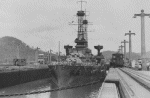 |
Post card of the New York (BB-34) transiting the Panama Canal, 25 July 1919. |
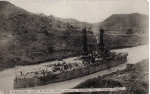 |
New York (BB-34) transiting the Culebra Cut in the Panama Canal. She was in the Caribbean in spring 1919, and that summer joined the Pacific Fleet at San Diego, her home port for the next 16 years. |
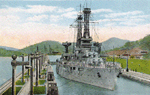 |
Post card of the New York (BB-34) passing thru the East Chamber of the Pedro Miguel Locks, Panama Canal, circa 1919. |
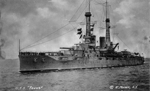 |
So many wires appear from the New York (BB-34) as if she is engulfed in a spider's web. When the Texas & New York were designed and constructed, the U.S. Navy still held to the notion that a commanding officer was better able to con his ship if he were in touch with the elements, thus most warships of this era were constructed with open air navigation bridges (the last vestiges of the era of sail). On the New York class this platform was situated behind and about 4 feet below the roof level of the conning tower. To afford some protection form the elements it is usually protected canvas wind breaks along the hand rails and an awning overhead. Both of the photos in question show this arrangement. Upon the U.S. entering WW I, the Royal Navy sent a team of officers "across the pond" to inspect the fleet we were sending over and offer suggestions that would better enable the American ships to operate along side the Royal Navy. Among the suggestions offered was the construction of enclosed pilot houses capable of withstanding the pounding of the heavy seas of the northern latitudes and afford protection from the cold winter temperatures and sea spray. Therefore in 1917 all battleships sent to the war zone were fitted with such a structure. On the New York and Texas the pilot house was attached to the forward cage mast at a level above the roof of the conning tower. Both of the photos show the original navigation bridge arrangement therefore they have to have been taken prior to 1917 and thus they can not have been taken on the west coast. Of course the problem with sister ships is how to tell one from the other. In the case of the Texas and the New York during the pre-WW I time period (1914-1917), the best tell tale is the arrangement of the searchlights on the masts. The Texas carried her searchlights on individual platforms mounted one above the other about half way up the foremast and below the level of the funnels (and thus the smoke) on the main mast. The New York carried her searchlights side by side on a single platform about a third of the way up the foremast and below the funnel tops on the main mast. Given that the photographs in question are from this time frame we see that the photo that N. Moser labeled Texas is in fact the New York and the photograph labeled New York is in the Texas. During her refit in 1917, the Texas's searchlights were rearranged to the same as the New York's but photos from 1917 to 1920 can be distinguished by the clearly visible pilot house and the fly-off platforms atop the Nos. 2 and 4 turrets. The presence of 3" AA guns atop the Nos. 3 and 4 turrets will date photos in the 1921-1925 time frame. |
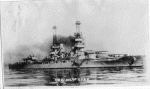 |
A smoky New York (BB-34) appears here, circa late teens-early 20's before any modifications were made in her original configuration. |
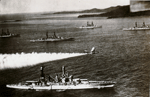 |
Foreground is definitely Tennessee (BB-43). In the middle and upper right are both BB-40 class; I would say the middle is Idaho (BB-42) (darker camouflage note also the fantail catapult) and upper right is Mississippi (BB-41), less certain but based on main mast platforms verses the New Mexico (BB-40). Middle background is New York (BB-34)(navigation bridge not over hanging conning tower). The far left background is the Texas (BB-35) (blunt bow, 2 funnels). The aircraft is a Naval Aircraft Factory / Curtiss / Canadian Aeroplane Ltd F-5L. The date of the photo has to be 1920-1921. By 1922 all 14' and 16" gunned BB's (except New York and Texas as the 5th turret did not leave enough deck space) had been fitted with a compressed air catapult on the stern. The presence of a stern A/C catapult on only one of the three 1916 program BB's suggest this early in the introduction of this equipment but late enough for the turret top fly-off platforms to have been removed from all ships present. In 1919 the Battle Fleet shifted its base to San Pedro in California where it remained based until shifted to Pearl Harbor. The Texas and New York were assigned to that fleet until they returned east for modernization in 1925. This would suggest that the photo was taken some where in the Pacific. The rich flora onshore suggest a tropical climate and the enclosed by would lead me to guess Panama or Gitmo. If the 1920 or 1921 Fleet problem was conducted in Atlantic waters could explain an Atlantic based aircraft with a Pacific based Fleet. |
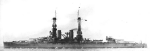 |
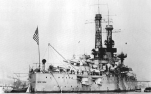
Port broadside view of the New York (BB-34). Radio antennae are visible and the white "E" on the conning tower stands for excellence on gunnery. Eight sided unit on the foremast is for secondary battery and searchlight control. Photo taken before the ship was modernized. |
 |
Stern view of the ship taken 1922-1923 showing 3" A.A guns, mounted in pairs; on turrets #3 and #4. These two turret tops were quite crowded as the long base range finders were mounted there too. Two more 3" guns are visible on the derrick tops too. Of particular interest is the seaplane on the fantail and the jury rigged crane used to handle it. |
 |
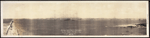
Panoramic photo of the U.S. fleet in Panana Bay (Pacific entrance to the Panama Canal) on 1 March 1923. 70 vessels are viewed; the Battle Fleet consists of all U.S. battleships from the Delaware (BB-28) through the Idaho (BB-42) . |
 |
The United States fleet in Colon Harbor, Atlantic entrance to the Panama Canal, 21 January 1924. What appears to be the New York (BB-34) or the Texas (BB-35) is in the foreground. |
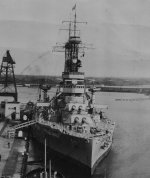 |
New York (BB-34) in dock, good image of the bow and the concentration dial, or "Clock", circa 1924.
The practice of gunnery at the beginning of the 20th century put a lot of emphasis on shooting first. Radio communications was still in diapers (cumbersome, Morse code, slow) and visual signals, light, flag hoist or semaphore, were not much better. When an enemy was detected it also took time to train and elevate the guns to shoot at him. In poor visibility this might give him the first shot. The range clocks, and their companion, the deflection markers, were developed to shorten the time needed to get off the first salvo. Concentration of fire was also a major consideration, and usually all ships of a division would fire on the same target. Fire control was based on mechanical analog devices that incorporated input from the optical range finders located at several places on the ship. In USN ships this included the top of the cage mast. Long range visibility under battle conditions was often poor. The heavy black smoke from burning coal just made it worse. But individual ships could be expected to have a reasonably clear view of the next ship ahead in the division line. The flagship was almost always in the lead, and could direct concentration of fire by passing range and deflection data to the other ships. This process was made much faster by simply training the flagships own guns in the direction of the enemy and displaying the ships own average rangefinder results on a circular display. Trailing ships often did not have as good a view f the enemy as the leader, but could observe where the leaders guns were aimed (and read numbers from the range clock) in order to set initial values for aiming their own guns. That is enough of the background theory. There was no CIC as we know it today, but there was a central fire control plot on each ship. This plot included a MECHANICAL device for determining and transmitting refined settings for azimuth and elevation of the guns. Initial inputs were often set manually. Communications between the plot and the gun turrets (and the range clocks) included up to 4 separate and parallel methods. First, there was a mechanical connection, usually a bicycle chain and sprocket drive to ensure equivalent movement. Second, voice tubes connected the plot with rangefinder positions and guns. Third, when they became available, there were internal communications telephones matching the above circuits. Finally, if other means failed, you could write a note and send it by messenger. There is an excellent series of articles on battleship gunnery fire control in this era in WARSHIP INTERNATIONAL. vol 38 numbers 1,2,3 (2001) and also vol 41. It is devoted to the plotting instruments, not range clocks. As a final note, I'm sure you already noticed that the range "clocks" are numbered from 1 to 10, not 1 to 12. The figures were usually given in thousands of yards. |
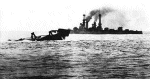 |
Final moments of Washington(BB-47) on 25 November 1924. Battleship New York (BB-34) in the background. |
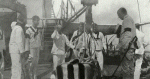 |
Eulogizing the dead before burial at sea., circa 1925. |
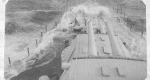 |
New York (BB-34) in a storm in mid-Pacific, between San Francisco California, and Astoria, Oregon July 1925. |
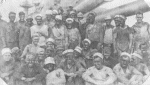 |
Some of the gang after coaling ship on the New York (BB-34), July 1925. |
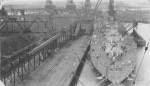 |
New York (BB-34) at coal dock Christobal, Canal Zone. 12 June, 1925. |
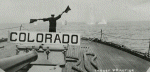 |
Towing for the Colorado (BB-45) in target practice, 1925. |
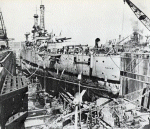 |
Texas (BB-35) in drydock at Norfolk Navy Yard in 1925 as she began modernization. The ship at the right is the New York (BB-34), also undergoing modernization. |
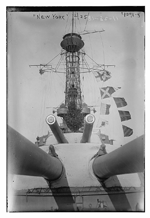 |
Unusual fire control device mounted on New York's (BB-34) top turret on Xmas, 1925. Signal flags read "Merry Xmas". |
| History 1927 - 1941 | |
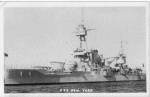 | New York (BB-34) after her major refit at Norfolk Navy Yard 10 April 1927. She still retains her individual secondary battery which would be removed sometime between then and 1932. |
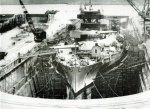 | New York (BB-34) undergoing her major refit at Norfolk Navy Yard 10 April 1927. After the Washington Naval Treaty of 1922 which scrapped major naval units, the U.S. used its money and materials in refitting existing fleet units. The New York's forward batteries are trained to port and starboard, and training markings painted on her 14-inch gun turret side. No funnels or control towers are on deck, her cage masts have been removed. |
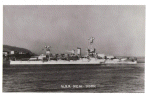 | New York (BB-34) after her 1926-1927 rebuild. She received new fire controls similar to the California/Colorado classes (BB-44-48), new boilers, masts, secondary weapons, and light weight machine guns. Her hull was rebuilt with bulges/blisters for torpedo and gun protection. |
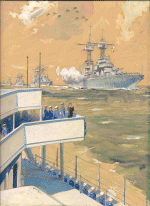 | Watercolor of a Presidential review during President Hoover's term of office, 1928-32. Crews line the rails of a Colorado class (BB-45-48) battleship as the ships pass in line astern of the reviewing stand with the airship Los Angeles (ZR-3) piercing the clouds accompanied by 9 biplanes. |
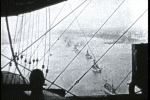 | View of the U.S. Battlefleet from above, possibly from the airship Los Angeles (ZR-3). |
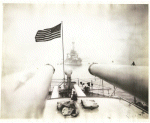 |
Picturesque bow view of the Florida (BB-30) from between the after turrets of the New York (BB-34). A fleet of 41 ships arrived in New York on 5 Feb. 1929 from southern waters for a two week visit fresh from winter maneuvers. |
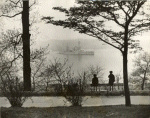 | New York (BB-34) viewed through the trees. A fleet of 41 ships arrived in New York on 5 Feb. 1929 from southern waters for a two week visit fresh from winter maneuvers. |
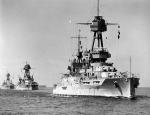 | New York (BB-34) leading Nevada (BB-36) and Oklahoma (BB-37) during maneuvers, 1932. The carrier Langley (CV-1) is partially visible in the distance. |
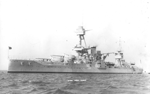 | Two large "E"s adorn the New York (BB-34) sometime during early-mid 1930's. |
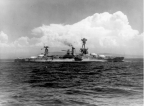 | Starboard side underway, August 1935. |
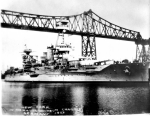 | New York (BB-34) in the Kaiser Wilhelm Canal, 1937. |
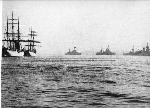 | Dawn in the harbor of Kiel, Germany. Left to right - training ships Gorch Fock and Horst Wessel, [Now USCGC Eagle], New York (BB-34), Wyoming (BB-32) and Arkansas (BB-33). USNIP., Jan.1938. |
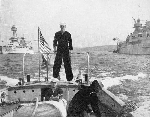 | American Bluejacket in Kiel, Germany. In the background the New York (BB-34), on the right the Wyoming (BB-32). USNIP., Jan., 1938. |
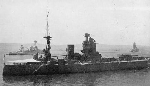 |
In 1937, carrying Admiral Hugh Rodman, the President's personal representative for the coronation of King George VI of England, New York (BB-34) sailed to take part in the Grand Naval Review of 20 May 1937 as sole U.S. Navy representative. HMS Nelson at the Coronation Naval Review with the New York and the French Dunkerque in the background. USNIP., March, 1938. |
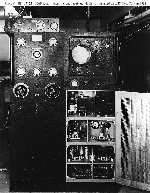 | XAF Radar (Transmitter and Receiver) which was installed on New York (BB-34) by the U.S. Naval Research Laboratory in late 1938. While mounted on that ship, this experimental 200 megacycle radar was tested at sea during the first months of 1939. |
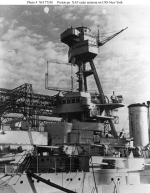 | View of the ship's forward superstructure, with the antenna of the XAF radar atop her pilot house, circa late 1938 or early 1939. Note the battleship's foremast, with its gunfire control facilities; her armored conning tower; and the rangefinder atop her Number Two gun turret. |
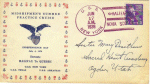 | Official Postal Cover from the battleship New York (BB-34) commemorating the Midshipmen's Summer Practice Cruise in 1939. |
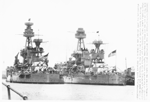 |
Norfolk VA., 13 April 1939. "Texas (BB-35) is bounded by New York (BB-34)". At least the battleships of those names are neighbors, as they stand tied up at Hampton Roads here during yesterday's preliminary off the Virginia capes. Janes Fighting Ships authority on the world's fighting battle craft, describes the Texas & New York as slow, hard to handle and bad sea boats in rough weather. |
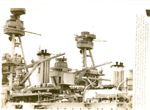 | Norfolk VA., 13 April 1939. "Steel forest for Americas shores". Menacing, gun laden tripod masts of the battleships Texas (BB-35) & New York (BB-34), both completed in 1914, are shown here as fleet began to arrive here yesterday for naval maneuvers off Virginia capes, preparatory to grand parade to N.Y. late this month. Both ships have 10 14" guns, 16 5" guns, and each can carry 3 aircraft. |
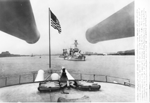 | N.Y. 29 April 1939. "Fleet steams up Hudson". Thirty seven vessels of the Atlantic Squadron steamed through N.Y. harbor and up the Hudson River today as part of the ceremonies connected with tomorrow's opening of the World Fair. This striking picture made from the deck of the New York (BB-34) flagship, shows the Texas (BB-35) followed by the Tennessee (BB-43). |
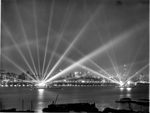 | N.Y. 3 May 1939. "The Navy's eyes probe the sky". Two battleships [looks to be the Texas (BB-35) & New York (BB-34)] of the Navy's Atlantic squadron made this pretty picture on the Hudson when their huge searchlights were played across the sky in search of imaginary aerial attackers. The lights of New York's myriad skyscrapers twinkle through from the background. |
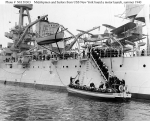 | Midshipmen and Sailors boarding a 50-foot motor launch, during the summer 1940 Naval Academy Midshipmen's cruise. Note whaleboat on the midships' davits and Curtis SOC-3 aircraft of Observation Squadron Five (VO-5) on deck and atop the catapult. The plane at right appears to be Bureau # 1090. |
| BB-34 USS NEW YORK | |
