
Letters

|
|
||
|
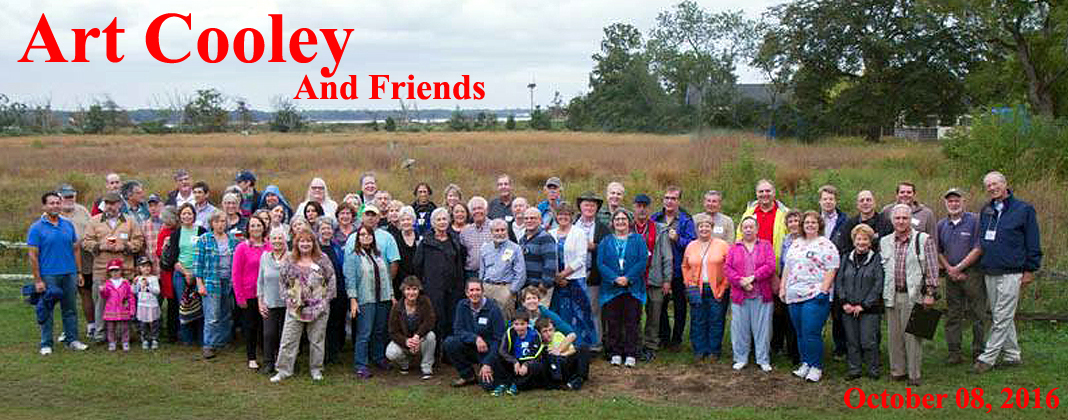
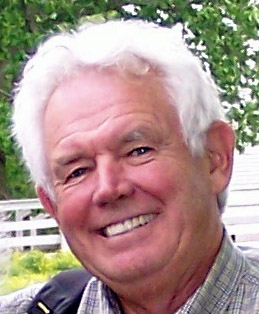
Dear Friends: The reunion at the Puleston’s last weekend was superb. The energy level among us all was off the chart. It would be hard to imagine that we could have had a better time. And, all of this occurred with a modest amount of rain for a short time; but the rain did nothing to dampen our spirits; indeed, it may even have heightened our enthusiasm. I hope everyone will contact the organizing committee of Alice Quatrochi (Chair), Jon Anderson, Ron Rozsa and Hellen Gelband and give them our thanks. I know there were other volunteers like Vickie Dominy Cairns who took care of the attendance, Jen, Sally and Peter who prepared the barn and outdoor site, and Pete Clement who kept the ‘home fires burning’ among other tasks but the heavy lifting was done by the four mentioned above. During my talk Saturday night, I mentioned the accomplishments in which each had played a role. I thought it would be good to summarize those good deeds here. I said that ‘you and your classmates have many achievements and here is a short summary you:
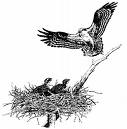
clearly, a series of accomplishments to be proud of. On Saturday morning Bill Konstant arranged for a boat Captained by Arne Bahler to inspect the Bald Eagle’s nest on the William Floyd Refuge. More than a dozen boarded his boat in Mastic and soon found the Bald Eagle’s nest, an adult eagle and a raccoon climbing a tree next to the nest. Later up the river an osprey flew by and dove into the water nearby and emerged with a fish. Those of us who birded on Long Island in the last century rarely saw an eagle so this was a special day. However, the next day in a boat Captained by Tim Hupfer we left Squassux Landing behind and within a very short time found two adult bald eagles roosting in the trees on the east side of the Carmans River. While Long Island now has four nesting pairs of bald eagles, Virginia has come in with some startling numbers. In 1970 there were 20 pairs of nesting bald eagles in the whole state. This past year there were more than 1000 bald eagle pairs. The protection of the eagles and the banning of DDT have allowed for a remarkable recovery. One attendee, who sees bald eagles all the time where she lives, waved them off by saying they were common as starlings. Clearly an overstatement but we get her gist. Without the banning of DDT, none of these observations would have been likely. An encounter with a whale changed the subject matter of my Topics in Biology class. Russ Hanscom, a social studies teacher, came to me one Monday morning and said that over the weekend a whale had washed ashore and it was now buried in the Southampton Town dump. My father knew the Superintendent of the dump and got permission for us to dig it up. We got a trailer, some shovels and some students and on a cold February day exhumed the whale. It stayed in our school’s courtyard for a few days but as soon as we reported that It was a pygmy sperm whale to Dr. Jim Mead at the Smithsonian Institution in Washington DC things changed. Jim said he would love to have it and could we freeze it. The only place big enough was the school’s cafeteria walk-in freezer. Dr. Dermer, the Principal, was reluctant but finally gave us permission. Dr. Mead came a few weeks later and picked it up and at the same time gave a talk to students about his studies of whales. A few years later I got a call from Jim and he said would we like the bones of the whale, and we said yes. To get them from DC to Bellport required a courier. Nathan Thompson was going to a Presidential classroom event in DC and I asked him to go by the Smithsonian and collect the bones. He did and brought them home, a most unlikely package for the Long Island Railroad. My recollection is that Laura Rowley and some fellow classmates put the beast together and it hung in room 204 for many years. Today’s Principal, Tim Hogan, tells me that it is still in the school. Another event is worth mentioning. One weekend, David Pate and three classmates were at Moriches Inlet on the east side when they saw a couple of hunters shoot and kill a harbor seal. In those days harbor seals were not common. He reported that to our class and at our urging wrote a letter for the Long Island Advance which laid out what they saw. Unbeknownst to us at the time, there was a draft bill in the New York State Senate which called for protection of seals. When we learned of it we decided to see if we could pass that bill. It took two years but the students were successful. It passed at the same time, 1972 that the Federal Marine Mammal Protection Act passed in Congress. David went on to work at Brookhaven National Laboratory and then served as Mayor of Bellport. Today he is working on reestablishing shellfish in Bellport Bay aided by the clean sea water that enters the bay through the new “Old Inlet.” While he is doing that the harbor seal numbers along the coast are increasing significantly. And, finally a word about Joe Beitel. He and Hellen Gelband suggested that the Topics in Biology class study the Carmans River including studies made from canoes as we paddled the length of the river. He went on to become a botanist with a special interest in ferns and lycopodiums. Because our travels crossed at Tomb 105 in Monte Alban, a Zapotec archaeological site near Oaxaca, Mexico, I have included a piece I wrote about him for the South Country Retired Educators Association. Please read what is in effect the codicil to this email, the attachment about Joe Beitel. And, as someone said, ‘thanks for the memories.’
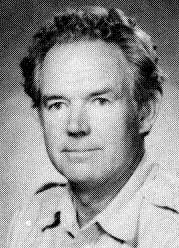
Art Cooley
|
||
|
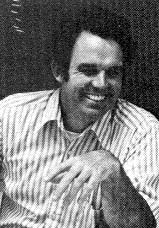
Searching Tomb 105 By Art Cooley I walked slowly around Tomb 105 at Monte Alban, a sacred, pre-Columbian site built by the Zapotec Indians near Oaxaca, Mexico. Unlike others, who were inspecting the temples, temples that rival some of the best of the old world, I was intent on finding a small fern in the chinks of the walls. The fern had been named for a former student of mine, hence my diligence. As I searched, I recalled the thread of events that led me to these hallowed Mexican grounds. At Bellport High, on Long Island, in the late sixties, classes were crowded and classrooms were scarce. After a few days of school, I was assigned another biology class that would meet in one of the home economics rooms. My class would be composed of two or three students from each of the crowded classes. Each teacher sent me the students he or she wished resulting in an eclectic array of skills and behaviors. One of those young teens would alter my life significantly. Erroneously, I assumed that he would be my student…and that I would be his teacher. Joe was enthusiastic, outspoken, eager and clearly bright. He was also, as I was to find out in the ensuing days, disruptive, rambunctious and questioning. The latter I could handle, the others were less endearing. But, we both survived and two years later he joined my ‘Topics in Biology’ class. By that time, a group of students along with Dennis Puleston and Keith McKenna were visiting local nature areas, ostensibly, to look at birds. But, Joe didn’t care for flying things. Looking at the ground, Joe discovered plants and particularly ferns and lycopodiums. It was, however, because of the ferns that I was searching the walls of Tomb 105. Teaching seniors in the spring semester after they have applied for college and, in some cases, received “early admissions” is a challenge that teachers know well. The disease is called “seniortis” and, if you think that a 10th grade sophomore is rambunctious, disruptive and annoying, you haven’t tried teaching college bound seniors. And, so it was that I was looking for something to grab the interest of this mostly senior class of biology students. We began a discussion about what topic might be interesting but were soon interrupted by the fire alarm. It was the first day warm enough for a fire drill after a long chilly winter. When the students returned, the discussion continued, but soon Joe and fellow classmate, Hellen Gelband, during the fire drill, had decided that we should study the Carmans River. I was seduced immediately. Wow, these kids want to study the ecology of the river, how cool. What I suspect is that they really wanted a day off campus to canoe the river. We did that. I liked canoeing too. And, we produced the first significant report on the ecology of the river…work and pleasure That report led to a more thorough study which protected the river under the New York State Wild, Scenic and Recreational Rivers System. Joe’s education of the teacher had just begun…symbiosis at its best. After graduating from Cornell, Joe went to the University Michigan to begin his PhD. He specialized in ferns and club mosses (lycopodiums) and his expertise in these areas led him far afield. But one of his more startling discoveries was found locally in a salad bowl in a Michigan restaurant. Out on a fern foray, (a foray is what people who study ferns call a field trip where they look for ferns), Joe had a salad with his lunch. As his fork poised over the salad, he noticed a leaf that looked unfamiliar or at least “out of place.” He asked the owner where that particular water cress, previously unknown in that area, came from. The owner, surprised, said “from the stream across the road.” He had found a rare plant in his salad. His discerning eye missed nothing, and don’t we wish we could still collect wild greens from the local stream? One expedition Joe joined went to the tepuis of south-eastern Venezuela, the land of Angel Falls, the tallest waterfall in the world and the site where Sir Arthur Conan Doyle set his novel Lost World. Fascinating choice…but the perfect place for Joe to practice “Caramba” biology, the Spanish word that can loosely be translated as ‘Holy Cow!’ Everything was new…well practically… the scientists who were dropped on top of Cerro Neblina, one of the tepuis, were elated with the thought of discovery and adventure. What he expected to study were endemic ferns, those found nowhere else; he didn’t expect to practice nursing. Bad weather stranded their expedition on the tepui for eight days and, as their food supply dwindled, some went foraging. A botanist found some blueberries and many ate them. Joe had read that one shouldn’t eat high elevation blueberries; sure enough, all who ate them were sick for many hours and unable to move. One, colleague, Mike Nee, even went “blind” albeit temporarily. After about eight hours all had recovered with Joe’s patient attention. True to his scientific training, he took notes on their symptoms as the toxin ran its course. He taught not only me but apparently his colleagues as well...albeit, a little late. As time went on, one expected Joe to find more rare plants…and to be aware of their by-products as used by scientists and pharmaceutical companies. And, so it came as no shock, to find his letter in a scientific journal noting that some condom manufacturers used lycopodium powder to “prevent the latex from sticking.” (Lycopodium spores provide the powder used in every high school chemistry lab to demonstrate that solids can explode, a “quality” they didn’t display on the condoms.) Using these spores seemed like a good idea at the time, but some people are sensitive to the powder and break out in a rash. While some concluded that this observation implied not to use condoms, Joe was quick to point out that all one needed to do was to “change brands;” others did not use lycopodium powder. Joe’s scientific awareness and teaching reached into new arenas. Joe’s career finally landed him a job at the New York Botanical Gardens where one of his colleagues was Dr. John Mickel. Together they visited Oaxaca numerous times and finally published the Pteridophyte Flora of Oaxaca, Mexico. Their knowledge of Oaxacan ferns convinced the author, Dr. Oliver Sacks, a neurologist and author of The Man Who Mistook His Wife for a Hat and An Anthropologist on Mars, to join them on a visit there. He describes their trip in his wonderful book, Oaxaca Journal. While Sacks was contemplating the huge complex of temples and tombs at Monte Alban and imagining how the Zapotec’s must have played ball (juego de pelota) in these hallowed arenas, he is interrupted, as he notes on page 133, “…in these lofty thoughts by the sight of John Mickel swooping on Tomb 105. ‘Astrolepis beitelii!’ he shouts in excitement (an Astrolepis not previously in our list). The pteridological passion in him is in full force. And, indeed, I see, as the rest of us are exploring Monte Alban…three tiny figures…far below…bent double, or crouching, or lying on their faces, examining the minute flora of the region with their hand lenses.” And, here I am in 2009 at Tomb 105 trying to recreate this scene, trying to see again Joe Beitel and his enthusiasm for ferns and clubmosses, indeed, to share again his enthusiasm for life. To help do that, I searched Tomb 105 for Astrolepis beitelli. By finding it I would strengthen that bond of teacher and student…even though it continues to be uncertain who was the student and who was the teacher; maybe we were just colleagues? Joe died in 1991, but his enthusiasm and scholarship continue to inspire those, like me, who continue to learn from him. As I stood next to Tomb 105, I recalled these events and pondered the meaning of these ancient ruins and the fact that a small, insignificant fern could be so important to me. Thanks, Joe…your “Ay Carumba” spirit inspired a fabulous Monte Alban/Oaxacan adventure. And, I want you to know, Joe Beitel, I’m still learning…. Published online in the newsletter of the South Country Retired Educators Association. |
bb | |
| cc | cc | |
|
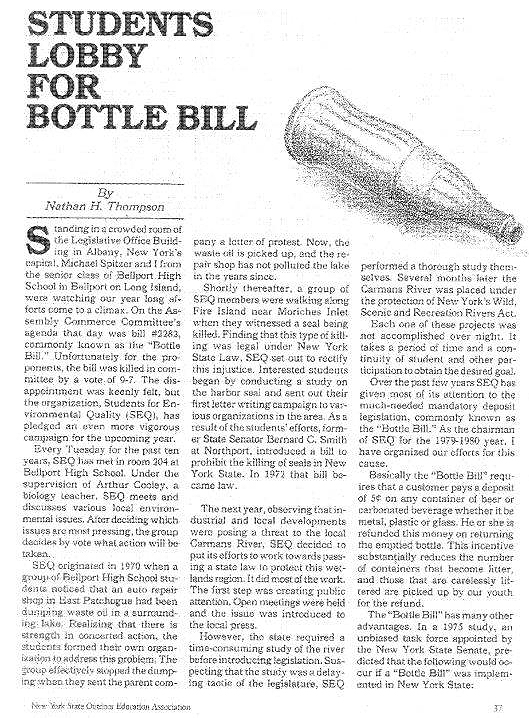
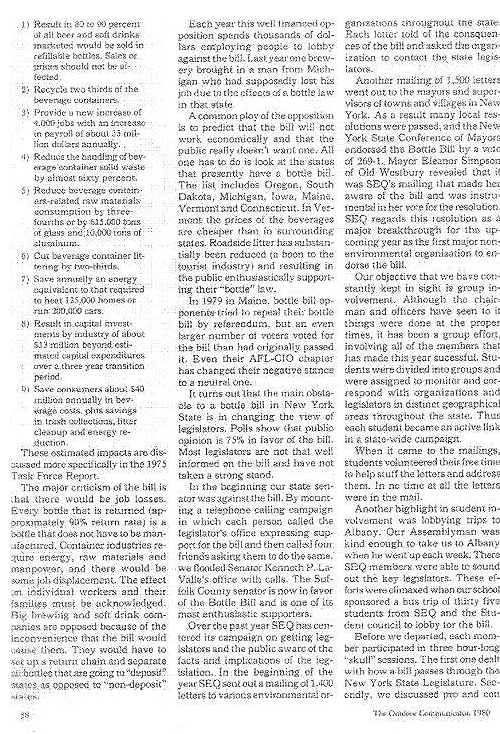
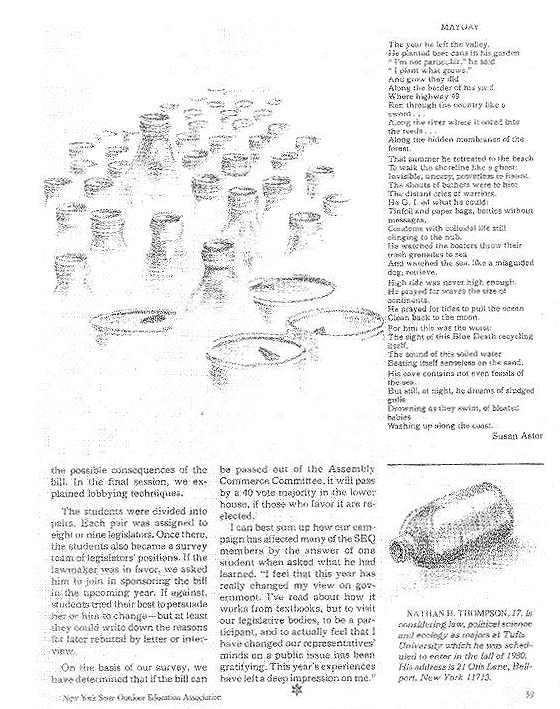
Dear Reunion members: This addendum is to show that the teacher is still being edited by a student and he is very appreciative that what was an oversight has been pointed out. This email is to note that I should have included the effort by SEQ to achieve a bottle deposit on beer and soda containers, first in Suffolk County and a short time later in New York State. SEQ played a major role in both efforts which were successful. I have attached an article written by Nathan Thompson and published in The Outdoor Communicator about SEQ’s efforts. Warm regards and thanks for noting this serious omission. |
||
 |
||
 |
||
 |
||
 Click
Here To View The History of SEQ Click
Here To View The History of SEQ |
||
|
Return
to Front Page |