
East Patchogue Monorail
Frederick W. Dunton was a spectator at the Boynton Bicycle Railroad Demonstration and saw great possibilities.

He envisioned a fast, speedy way to travel from the New York
City to Long Island's eastern towns in addition
to Port Jefferson's steamers to Connecticut. He became acquainted with Mr.
Boynton, and utilizing his concepts
he formed The New York & Brooklyn Suburban Investment Company.

F.W. Dunton was named president and George
E. Hagerman the secretary & treasurer.
Dunton invested his energy on the construction of the railroad while Hagerman
operated a large lot selling development in the area of Bellport & East
Patchogue.

Work had begun on the first twenty miles of
track when problems begun to plague the operation.
Austin Corbin, president of the Long Island Railroad and Frederick Dunton’s
father in law opposed the rival
railroad and blocked its construction. “To extend this road from sound to ocean
it will be necessary to cross
the property of the Long Island Railroad. Every effort will be made to prevent
such a crossing, without which
Mr. Dunton’s pet scheme, so far as crossing Long Island is concerned, will not
be realized."

The "Rocket", the electric railcar of the Boynton Bicycle Electric Railroad, in an illustration from Scientific American, 17th February, 1894.
The Boynton type monorail was built in 1894
between East Patchogue an Bellport, Long Island, NY
When the experimental car, The Rocket, came through from Brooklyn and as it was
moved along South Country Road
being pulled by twenty four powerful oxen, it attracted great crowds. The beasts
were as much a curiosity as the car itself.
Mr. Dunton completed a one and a half mile test track, running
north to south on a location in East Patchogue.
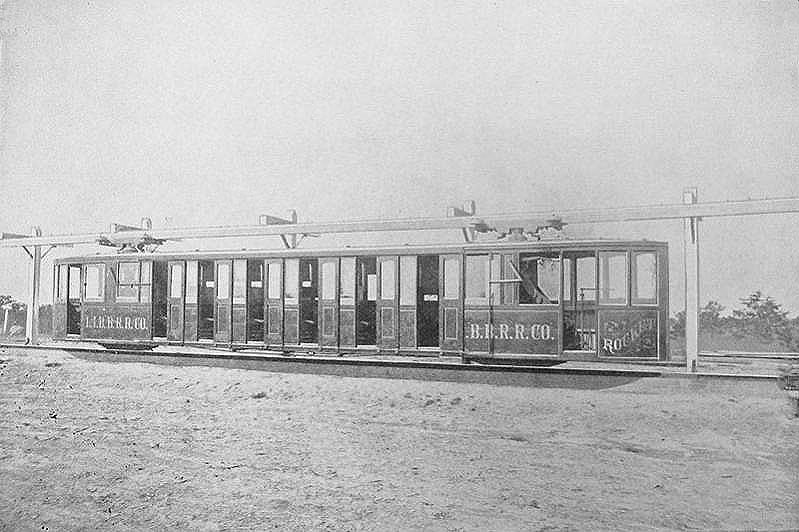
The Rocket, East Patchogue 1894
In 1894 the trial runs began as dignitaries and VIP’s were invited from all over
the Northeast.
The Bicycle car at East Patchogue began running May 10th, running Thursdays from
10 in the morning until 4 in the
afternoon and on Saturdays the time of running was extended to 7 in the evening.
Free stages from Patchogue and Bellport
depots to the Bicycle Road were run on the arrival of the trains.

The electric powerhouse was built on the south end of the
track by the bay and the track ran north to the central line of the Long Island
Railroad.
The railroad consisted of heavy, wooden framework with a single rail at the top
and bottom.
Today, the old right of way is now called South Dunton Avenue.
Ultimately the system failed. The cost of
the enterprise was estimated to be $1.6 million. They never made it.
The promoters are just names now. Hagerman, a small lovely community and Dunton,
a road in East Patchogue.
Even in failure these men should be remembered as visionaries who helped shape
Long Island into what it is today.

South Dunton Ave in Hagerman, Long Island
The "humps" in the road are due to the raised
beds of the old Bicycle Railroads Right of Way.
The streetbuilders were too lazy to level it so they paved it over!
